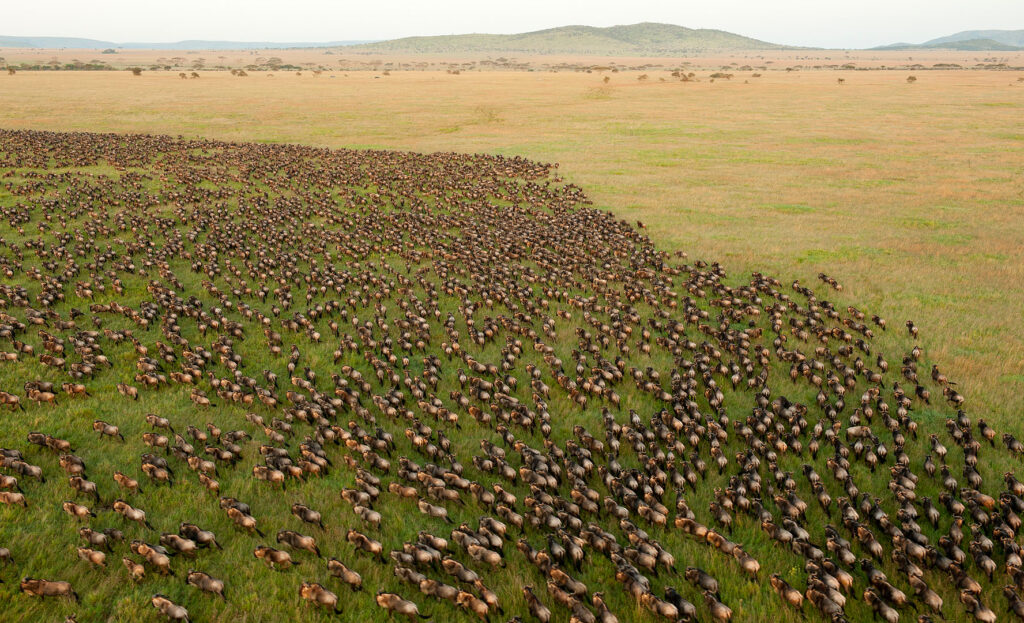
Quick answer: Choose your travel window around the migration experience you want, then book accommodation in the appropriate region—not simply anywhere labeled “Serengeti.” January–February is a useful starting point for calving research; June–July for the westward movement; and July–October for a northern safari with possible Mara River crossings. These are seasonal tendencies, not appointments with wildlife. Build in repeat game-drive days and a worthwhile alternative if the main herds are elsewhere. (tanzaniaparks.go.tz)
Planning information checked October 10, 2026.
1. Decide which migration experience matters to you
“Seeing the migration” and “seeing a river crossing” are different goals. The seasonal cycle includes calving on southern short-grass plains, westward movement as conditions dry, and a northern dry-season refuge around the Mara River. Crossings are one part of that wider movement. (cms.int)
Before requesting quotes, rank these possible priorities:
- Watching large herds spread across open country.
- Looking for calves and observing herd behavior.
- Spending time near the Mara River, accepting that a crossing might not happen.
- Photographing animals in their landscape.
- Combining migration-focused drives with broader wildlife viewing.
Then write one sentence describing what would make the trip worthwhile without your first-choice sighting.
For example: “We would love a crossing, but would still value several days watching herds, searching for predators and photographing northern Serengeti landscapes.”
That sentence gives an operator a more useful brief than “guaranteed migration safari.” Asilia’s own Sayari information explicitly states that river crossings are not guaranteed. Treat any contrary sales promise as a reason to ask further questions. (asiliaafrica.com)
2. Use seasonal patterns to shortlist a region
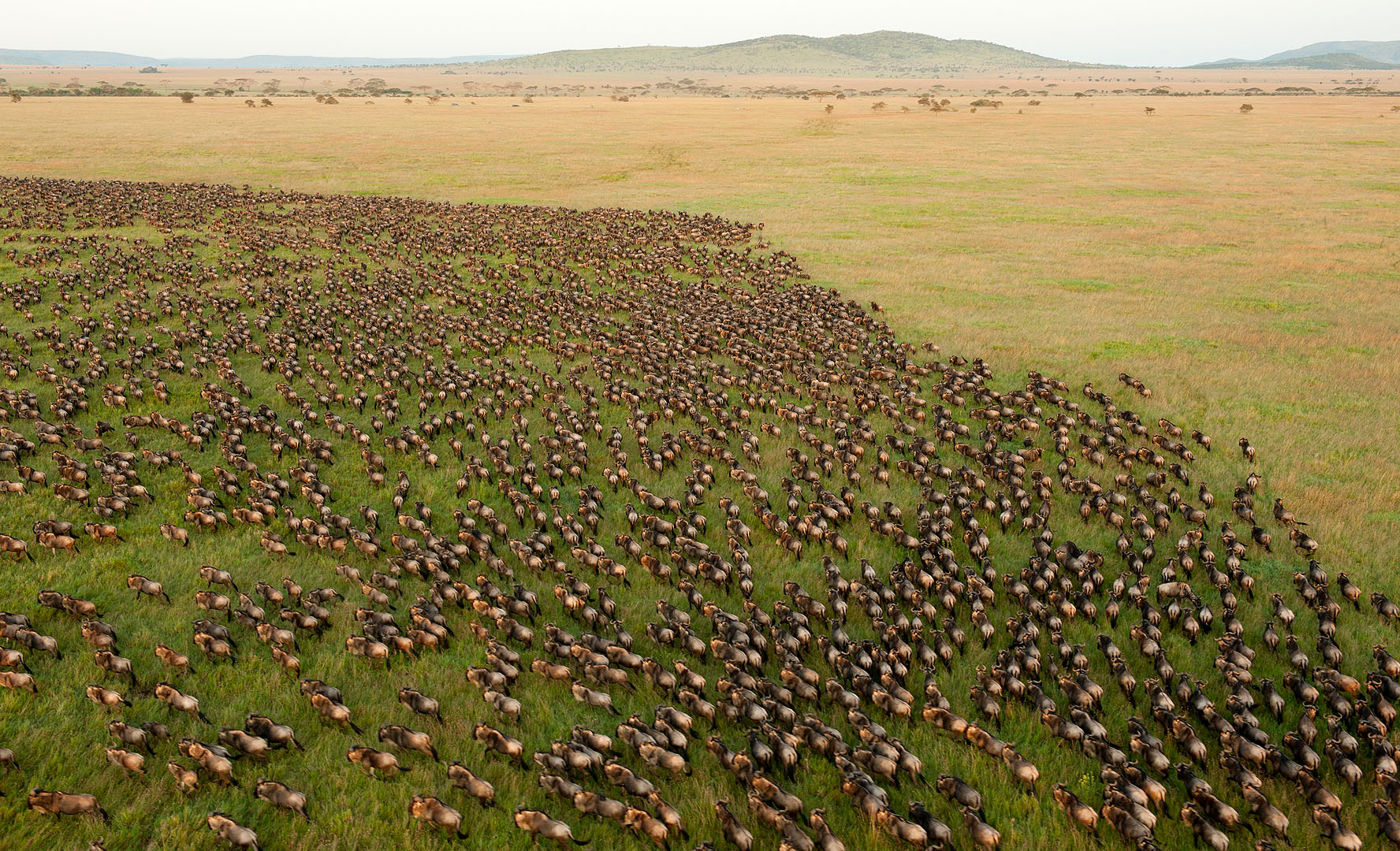
Seasonal rainfall drives wildebeest migration. The Convention on Migratory Species describes a broad progression from southern wet-season grazing to the Western Corridor, then farther north as seasonal rivers and forage diminish, followed by a southward return when rains resume. (cms.int)
Use that pattern to narrow your search:
| Travel window | Region to investigate first | Planning implication |
|---|---|---|
| January–February | Southern short-grass plains | TANAPA identifies these months with calving. Prioritize access to the plains rather than a northern river location. |
| March–April | Southern plains, subject to current conditions | Research wet-season access and each camp’s operating dates; do not assume every seasonal camp remains open. |
| May–July | Central-to-western route and Western Corridor | The historical pattern includes westward movement beginning around May and Western Corridor use in June–July. Ask why the proposed base suits your particular dates. |
| July–October | Northern Serengeti, including the Mara River area | Appropriate for a crossing-focused plan, but not a crossing guarantee. |
| November–December | Southward transition and southern return | Rainfall and the return movement matter more than a rigid calendar boundary. Check both camp location and opening date. |
The table combines park-authority guidance, the CMS migration description and directly published camp information. It is a regional planning framework, not a forecast of herd positions. (tanzaniaparks.go.tz)
If your dates fall between the broad phases, ask an operator to explain the trade-off between two plausible regions. A reasoned answer should identify the expected seasonal pattern, the actual camp location and an alternative wildlife plan.

3. Understand what historical evidence cannot predict
The CMS fact sheet’s underlying movement project covers 19 years between 1999 and 2022. That makes it useful evidence for broad migration geography, but it is not a live tracker or a prediction for a particular departure. (cms.int)
Keep three kinds of information separate:
- Historical pattern: where migrating animals generally use wet- and dry-season habitats.
- Recent observation: where guides have recently seen herds.
- Forecast: where someone expects those herds to be during your stay.
Before accepting a migration update, ask:
- When was the observation made?
- Was it firsthand or passed along?
- Which broad region did it describe?
- Does that location remain practical to reach from the booked camp?
- What is the plan if the animals move before arrival?
Use recent reports to inform daily guiding, not to justify an expensive last-minute change automatically. Request the full financial and logistical consequences before changing accommodation.
A useful booking decision is one that remains acceptable under more than one wildlife outcome.
4. Check the actual location of fixed and mobile camps
A permanent camp stays in one place; a seasonal migration camp can occupy different locations during the year. The relevant question is not simply “Is it mobile?” but “Where will it be during our exact stay?”
Directly published examples show the distinction:
- Sayari: Asilia identifies this as a permanent northern Serengeti camp near the Mara River. Its page lists an April–May closure, illustrating that permanent does not necessarily mean open year-round. (asiliaafrica.com)
- Ubuntu Migration Camp: Asilia publishes a northern Lamai Wedge location from June to mid-November, and a southern Kusini location from mid-December to mid-March. Confirm the exact dates for your intended travel year. (asiliaafrica.com)
- Serengeti Safari Camp: Nomad describes its camp moving four or five times annually between Serengeti sites. That description does not establish the site for your booking; request written confirmation. (nomad-tanzania.com)
These are examples of operating models, not endorsements.
Ask for the camp’s seasonal site, nearest airstrip, transfer arrangements and whether any relocation overlaps your dates. Also ask what the camp means by “following the migration”: scheduled seasonal moves, responsive relocation, or simply a location chosen for expected seasonal access.
Compare comfort separately from location. A beautiful room does not resolve a mismatch between your wildlife goal and your base.
5. Treat driving distance as part of the itinerary
TANAPA lists separate airstrips serving central, southern, western and northern parts of the park, including Seronera, Kusini, Kirawira, Kogatende and Lamai. The arrival point should match the booked camp and intended region. (tanzaniaparks.go.tz)
For every transfer, request:
- The actual road distance between the named properties.
- An estimated driving-time range for your travel month.
- Whether that estimate excludes wildlife stops.
- Time allocated for lunch, comfort stops and formalities.
- Expected arrival time and whether any meaningful game drive remains.
Do not treat a straight-line map measurement as a road distance. Equally, do not accept “game viewing en route” as a substitute for a clear transfer schedule.
For a short migration-focused trip, compare two complete options: driving into the chosen region versus flying to a suitable airstrip and transferring locally. Include airport transfers, camp transfers and any luggage restrictions in that comparison.
If a quotation proposes sleeping in one region while repeatedly searching another, ask for the daily return-driving estimate. Decide whether you actually want that much vehicle time.
Practical rule: label relocation days as relocation days until the operator demonstrates otherwise. Treat any wildlife encountered during them as a welcome addition, rather than counting the entire journey as dedicated viewing time.
6. Build a route that protects your viewing days
The following are illustrative six-night structures, not confirmed packages. They assume accommodation and transfers are available and exclude international travel.
January–February: southern focus
- Nights 1–4: One southern base selected for access to the short-grass plains.
- Nights 5–6: A central base for broader wildlife viewing, if the transfer fits your preferences.
The southern emphasis follows TANAPA’s calving guidance. The central extension is an editorial suggestion for variety, not a requirement or a guarantee of particular animals. (tanzaniaparks.go.tz)
June–July: investigate the westward transition
- Nights 1–3: A central or western base chosen after discussing the seasonal movement.
- Nights 4–6: A second base only if its different location justifies the transfer.
The CMS description supports investigating the Western Corridor during this period. Do not add a northern stop solely because a brochure’s calendar changes month halfway through your trip. (cms.int)
July–October: northern focus with an alternative
- Nights 1–4: A northern base for repeat drives and possible river visits.
- Nights 5–6: Either remain north or add another region for variety.
Here is the scheduling arithmetic: arriving on Day 1 and leaving on Day 5 gives three intervening days—Days 2, 3 and 4—for full-day planning. Moving camp on Day 3 uses one of those days for relocation. The arrival and departure days may allow drives, but their value depends on the actual transfer times.
For someone whose main goal is patient northern viewing, staying put may therefore be preferable to adding another camp. Northern seasonal suitability supports the location choice; it does not establish a probability of witnessing a crossing. (asiliaafrica.com)
November–December: confirm openings before choosing the route
Request proposals explaining both the southward transition and the proposed camps’ operating dates. Ubuntu’s published schedule, for example, leaves an interval between its northern and southern seasons. Do not assume a mobile camp covers every transitional week. (asiliaafrica.com)
7. Agree on a fallback—and responsible viewing
The Serengeti offers more than migrating herds. TANAPA describes grasslands, riverine forests, swamps, woodlands and rocky kopjes, alongside wildlife including lions, leopards, elephants and buffalo. These provide a basis for broader viewing, without guaranteeing sightings. (tanzaniaparks.go.tz)
Before booking, ask the guide or operator to outline an alternative day:
- Which accessible habitats would they explore?
- Would the day combine herd searching with other wildlife?
- Could the schedule include landscape and bird photography?
- How would they decide whether to keep waiting at the river or move on?
Agree that the trip need not spend every available hour pursuing one event.
At the Mara River, follow designated viewing arrangements. TANAPA’s published crossing guidance requires vehicles to remain stationary in designated areas, leave animals room to pass, respect site capacity and keep visitors inside vehicles. It also prohibits picnic activity on the riverbanks. (tanzaniaparks.go.tz)
Do not ask a driver to approach a crossing herd or block its route for a photograph. Follow current signs and ranger instructions if access arrangements differ from earlier published guidance.
8. Check these details before paying
Avoid the recurring planning mistakes: buying a park name rather than a location, assuming “mobile” means continuous relocation, counting transfer days as full viewing days, and making one sighting the only measure of success.
Before committing, obtain written answers to these questions:
- Location: Where is each camp during our exact dates?
- Seasonal reasoning: Why does that region suit our main interest?
- Transfers: What are the road distances, time ranges and flight arrangements?
- Viewing time: How many days are genuinely free of inter-camp transfers?
- Vehicle use: Are drives shared or private, and what flexibility is included?
- Charges: Which accommodation, transport, guiding and park-related costs are included?
- Changes: What happens financially if we request a different camp?
- Fallback: What will we do if the main herds are beyond practical reach?
- Expectations: Does any wording imply guaranteed crossings or animal encounters?
Choose the proposal that explains its assumptions clearly—not the one making the most confident wildlife prediction.
The strongest migration itinerary pairs a seasonally sensible base with enough time to explore, transparent logistics and wildlife interests that remain worthwhile when nature does something unexpected.